
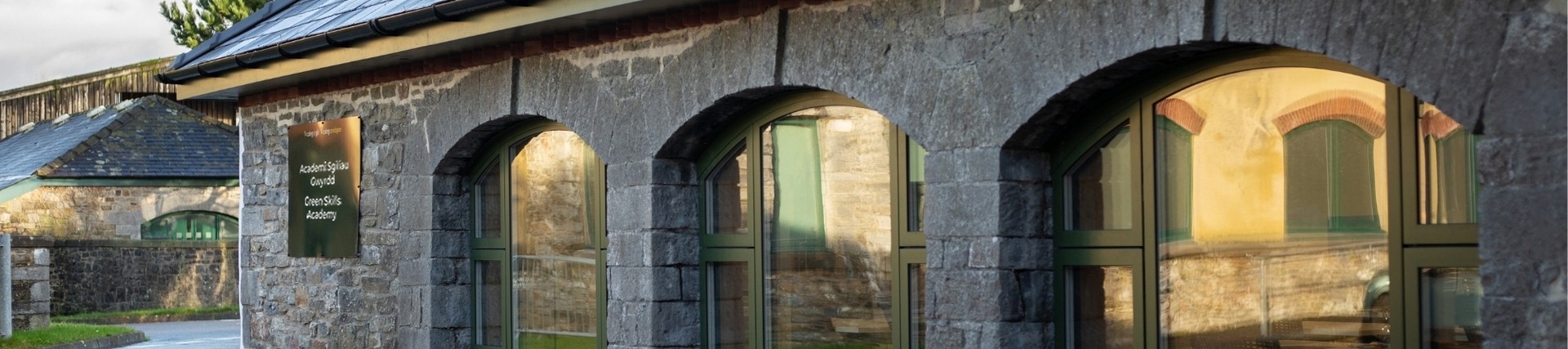
The Green Skills Academy Centre
The Arches: A Historic Building Reimagined for a Sustainable Future
A 19th Century cart house at Coleg Sir Gâr’s Gelli Aur campus has been transformed into a state-of-the-art training hub for the Green Skills Academy, hosting environmental sustainability, renewable energy, and low-carbon construction skills courses.
Funded by the UK Shared Prosperity Fund (UKSPF) through Carmarthenshire County Council as part of the college’s Skills 24 programme, this innovative redevelopment not only delivers a sector-leading teaching facility but also preserves an important piece of local heritage — demonstrating that traditional buildings can play a key role in Wales’s journey to net zero.
The Arches building functions as a live teaching model, where learners, employers, and community groups can experience sustainable technologies in action — observing how systems interact and how low-carbon design principles are applied in real-world contexts.
Designed to support the delivery of retrofit, renewable energy, and energy management qualifications, the centre also serves as a demonstration hub for manufacturers, local authorities, and industry partners.
By blending innovation, education, and heritage, the Green Skills Academy’s new building stands as a powerful example of how past and future can come together to build a more sustainable Wales.
Building Performance
The building’s performance demonstrates what can be achieved through deep retrofit and sustainable design:
- EPC Rating: A+
- Annual Carbon Emissions: –5.65 kg CO₂ per m² (net-carbon-negative)
- Comparison: A similar, unrefurbished building would typically emit tens to hundreds of kilograms of CO₂ per m² per year.
This means that The Green Skills Academy generates more energy than it consumes — a remarkable achievement for a historic stone structure.


A Live Teaching Model
The Green Skills Academy is far more than a classroom — it is a working example of sustainable design.
Learners studying retrofit, renewables, and energy management can observe and analyse real data from the systems in place. Employers and industry partners can use the space for demonstrations, CPD, and collaborative innovation.
The project embodies the principle: “Build tight, ventilate right.” It stands as a testament to how education, heritage, and sustainability can come together to create meaningful, measurable change.
Funding and Acknowledgements
This project was funded by the UK Shared Prosperity Fund through Carmarthenshire County Council, as part of the Skills 24 programme.
Technologies and Techniques
-
Three PV arrays — two south-facing and one north-facing — generate renewable electricity for the building. Combined, they feed into a 10 kW battery storage system and a Smart Energy Hot Water Divertor that automatically redirects excess energy to heat water, ensuring no energy is wasted.
-
A 6 kW Air Source Heat Pump extracts heat from the air to provide hot water and underfloor heating. This system replaces traditional fossil fuel heating, drastically reducing emissions
-
Heating is delivered through underfloor pipes laid in limecrete over a base of recycled foam glass. The system is divided into three zones (classroom, workshop, and lobby), each controlled via a SMART Honeywell Evohome system. The limecrete and foam glass base provides insulation, strength, and breathability — ideal for historic stone buildings.
-
The limecrete and recycled foam glass allow moisture to move naturally, preventing damp and improving insulation. A breathable linoleum floor with a separating mesh layer maintains vapour permeability, while perforated skirting supports air circulation.
Walls are finished with a Calsitherm and Diathonite system — combining cork-based and calcium silicate materials for insulation, breathability, and mould resistance.
-
Sheep’s wool and woodfibre insulation, combined with a smart vapour control layer, create a sustainable, low-carbon building envelope. These natural materials regulate humidity, provide acoustic benefits, and reduce condensation risk.
-
The classroom features an MVHR system that supplies fresh air while recovering heat from outgoing air, improving indoor air quality and reducing energy waste.
-
The original arched windows were refurbished and fitted with Velfac 200E triple-glazed composite frames, offering exceptional energy performance while preserving heritage character.
The original roof was replaced with a prefabricated scissor truss structure, insulated using the same natural materials found in the walls and finished with a hemp plaster ceiling. -
A recycled foam glass French drain around the perimeter prevents moisture ingress and cold bridging. The raised floor and modified archway entrance provide enhanced flood resilience without compromising the building’s heritage.
-
All lighting is sensor-controlled and daylight-responsive, reducing energy use while maintaining excellent learning conditions. The SMART control system allows remote monitoring and adjustment of heating and hot water systems.
-
During the renovation, large historic slate slabs were uncovered beneath the floor and roof slate was reused where possible. Slate slabs were cut down and reused as window sills — preserving the building’s history while reducing waste.

Visit and Learn More
Visitors, employers, and community partners are welcome to explore The Green Skills Academy and see how this pioneering retrofit combines traditional construction with modern sustainability.